For years, computer vision has been one of those technologies that sounds transformative and feels out of reach. If you run field inspections, you know the pitch: an AI that spots faults from a photo. You also know the catch. Building one has meant hiring machine-learning engineers, gathering thousands of labelled images, standing up cloud infrastructure, and waiting months for a model that may or may not survive contact with a muddy chamber and a spotty mobile signal.
SkillsBase Forge removes that catch. It is a platform that lets the people who actually know the work, inspectors, trainers, and quality managers, build their own AI fault-detection models and get them onto their team's phones. No code. No data science team. No infrastructure to manage.
Where Forge comes from
Forge did not appear out of nowhere. It is the productised version of the same computer-vision technology that powers our AI Virtual Buddy, the tool Openreach engineers use to check installation quality in real time. We built that model-training pipeline for our own team first. Forge opens it up so any organisation can do the same for their own faults, their own standards, and their own equipment.

So what is Forge, exactly?
Forge is a web portal paired with a branded mobile app. In the portal you label photos, train models, and manage them over time. Through the app, or your existing tools via REST API, those models reach inspectors wherever they work. The core idea is simple: most computer-vision tools stop at labelling and hand you a model file. Forge takes you all the way to a model running on a phone in someone's hand.
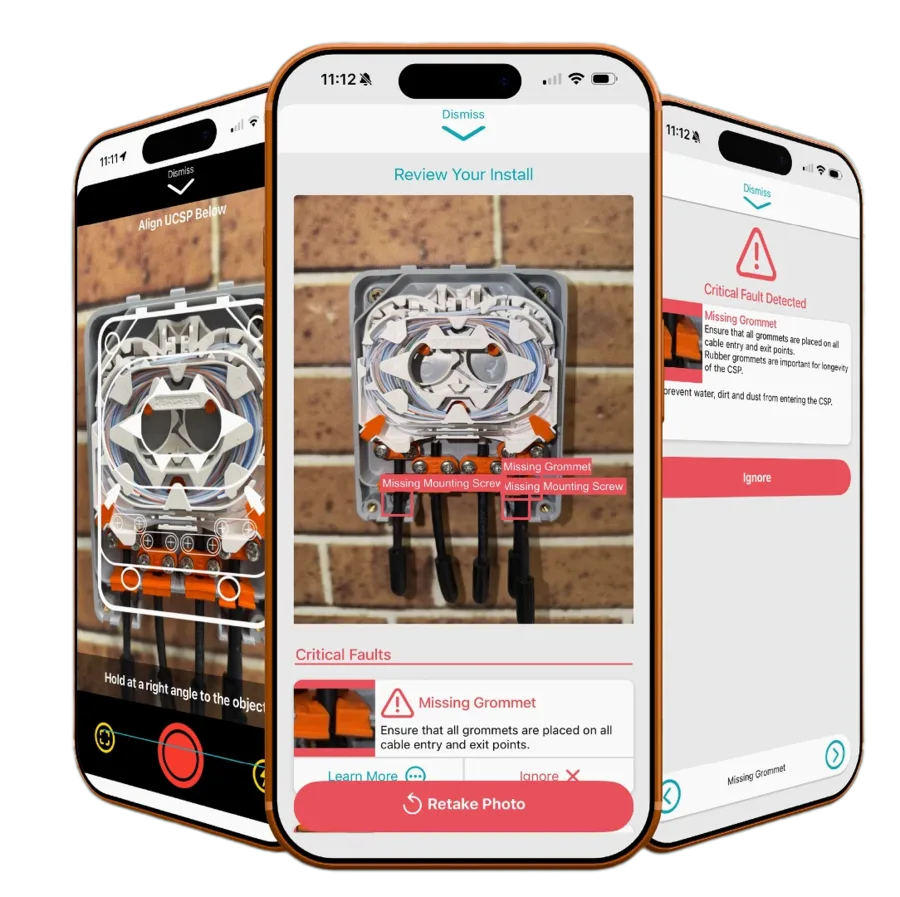
Most computer-vision tools were built for ML teams shipping cloud APIs. Forge is built for inspection teams shipping models to phones in the field.
The idea behind ForgeHow it works, in four steps
The whole journey runs from a folder of photos to AI in the field. Here is the shape of it:
From photos to field, start to finish
- Label. Draw a box around a fault in a photo, name it, and repeat. No machine-learning background needed, just your knowledge of what "good" and "bad" look like.
- Train. Press one button. Forge handles the infrastructure, the compute, and the model tuning. No data scientists, no servers to configure.
- Build a workflow. Combine your model with tutorials, capture steps, and feedback forms so inspectors are guided through the whole job, not just handed a raw prediction.
- Deploy. One tap pushes the workflow over the air to every inspector's phone or fixed-site camera. Devices keep working offline and sync when they reconnect.
What you actually get
Forge is designed to be usable by a real team on day one, not a science project. A few things worth knowing before you start:
Crucially, humans stay in the loop. You set the confidence threshold, inspectors review the edge cases that matter, and every one of those reviews feeds the next training round. The model gets sharper the more your team uses it.
How Forge is different
Generic computer-vision platforms are powerful, but they were built for machine-learning teams shipping cloud APIs. They assume you have the people, the data, and the time. Forge assumes the opposite: that your expertise is in the work itself, and that the model needs to live on a phone in a van, not in a data centre. That difference shapes everything, from the labelling experience to offline-first deployment and one-click retraining.
Who it is for
Forge is built for inspection at scale. If your teams check the quality of physical work, fibre splices, copper terminations, installations, civils, or plant, and consistency matters across a large, dispersed workforce, Forge turns your best inspectors' judgement into a model everyone can carry. It is the natural next step for the same telecoms and utility teams already using SkillsBase to train and assess their people.

Be first to build your own AI
Forge is rolling out through early access. Join the waitlist and we will reach out personally when it opens for your team.
Explore Forge