
A convincing demonstration is not enough to establish whether an AI inspection tool is ready for operational use.
Demonstrations are, by design, carried out on examples chosen to show a system at its best. Field conditions are rarely so tidy. Lighting changes, cameras are held at different angles, equipment varies between installations and some faults are subtle. A tool that performs well in a demonstration still needs to be assessed against the images and defects it will encounter in practice.
Two questions that matter
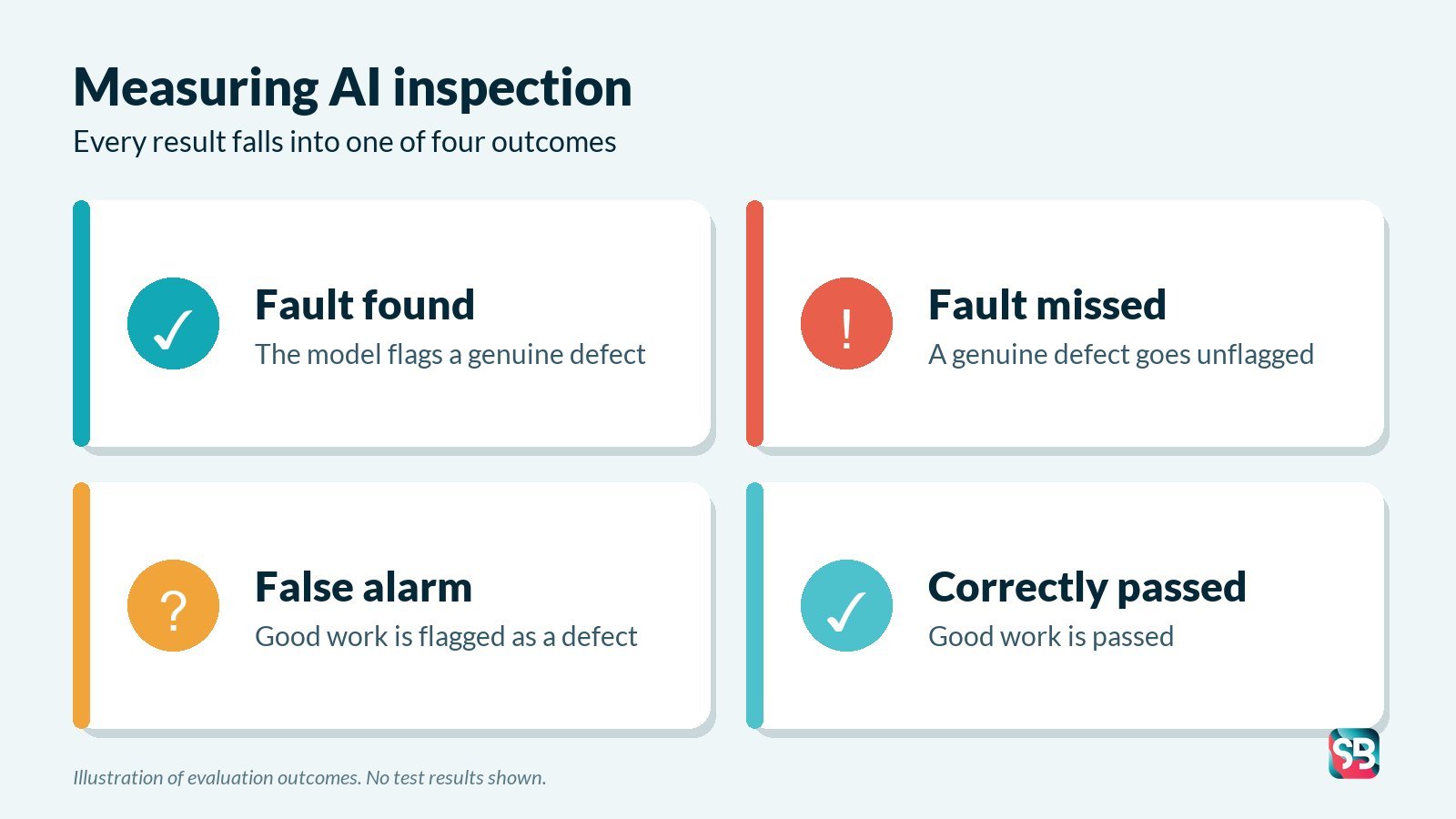
For a quality team, two questions matter: how often does the model identify a genuine defect, and how many defects does it miss? A system that raises frequent false alarms can create unnecessary work, while one that overlooks important faults can give misplaced confidence.
These two measures often pull in different directions. Tuning a model to catch every possible fault tends to increase false alarms; tuning it to avoid false alarms risks missing real faults. The right balance depends on the consequences of each kind of error for the organisation, and that is a decision for the quality team, not the technology alone.
Purpose-trained and general-purpose models
SkillsBase has compared purpose-trained computer-vision models with general-purpose vision AI using real telecommunications inspection images. In our internal testing, the model trained for the specific defects performed substantially better on that task. The findings relate to the dataset and defect types tested, rather than establishing a universal result for every AI system.
For organisations evaluating inspection technology, the lesson is to test against the work the system will actually perform. Recognising an object in a photograph is not the same as identifying a particular defect in that object.
What to look for in an evaluation
A useful evaluation should be transparent about how it was carried out. Teams reviewing an inspection tool may want to ask:
- Which defects was the model tested on, and how was each defect defined?
- Were the test images kept separate from the images used for training?
- Do the test images reflect real field conditions, including poor lighting and difficult angles?
- How many genuine defects did the model miss, and how many false alarms did it raise?
- What happens when the model is uncertain, and who reviews those cases?
Image quality, the definition of a fault and the range of examples all deserve attention when interpreting results.
A result reported without this context can be difficult to interpret. A high score on a narrow or carefully selected set of images may say little about performance on the varied images a field team produces every day.
Supporting the final decision
Our priority is to make AI performance understandable: what the model has been tested to recognise, where its limitations remain and how it should support the person making the final decision.
Clear evaluation builds the trust that operational use requires. When engineers and supervisors understand what a model does well and where it needs a person’s judgement, they are better placed to use it effectively. It also gives organisations a sound basis for deciding where AI inspection should be introduced first, and how its performance should be monitored once it is in use.
To discuss how to evaluate an AI inspection model against your own defects, contact the SkillsBase team.